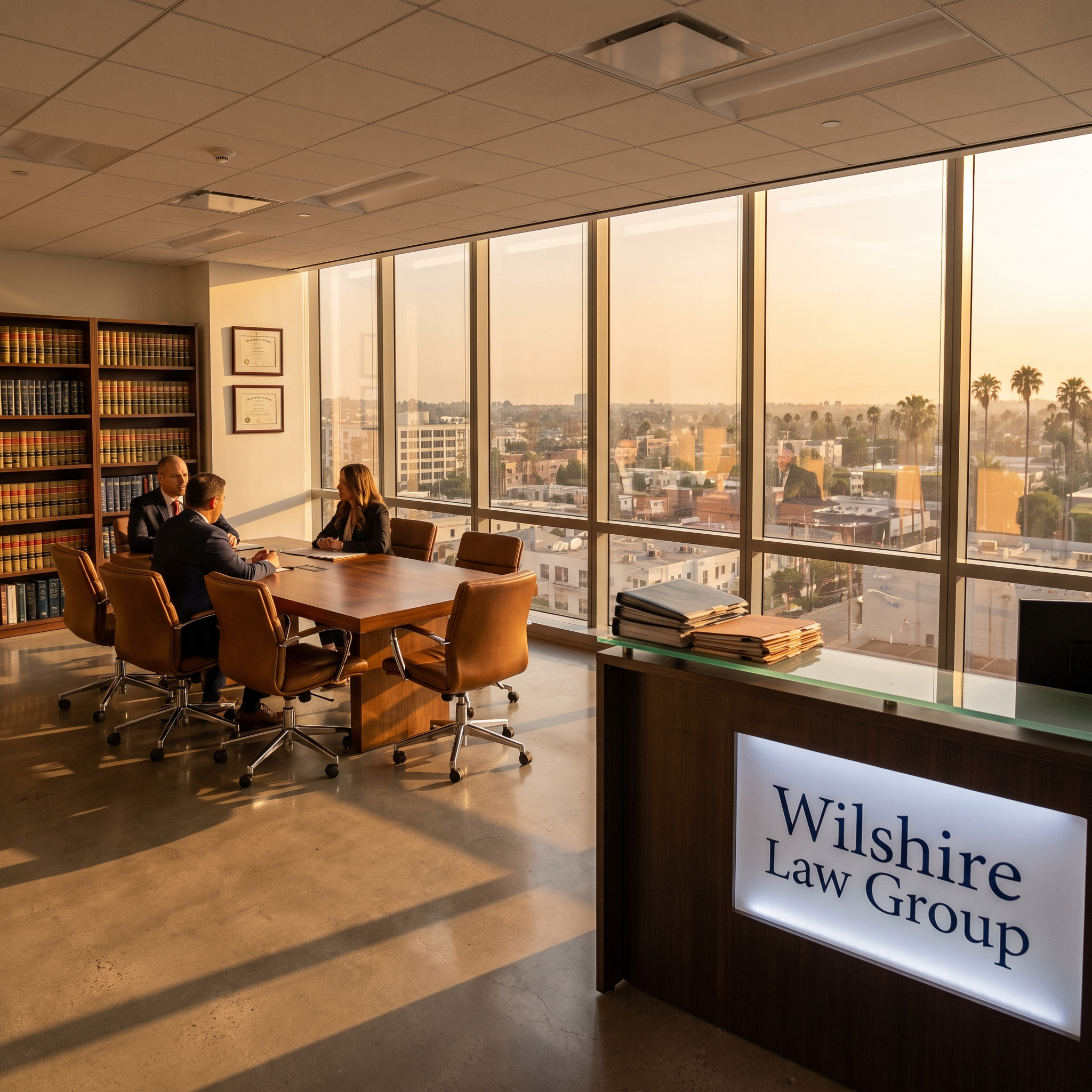
Your car got hit on Wilshire. The other driver's insurer is already calling. You have not talked to an attorney yet, and what you say in those first calls matters more than most people realize.
These are the seven questions our office at 12100 Wilshire Blvd hears most in the first week after a Westside crash.
What do I need to do at the scene?
Call 911 and stay. California Vehicle Code section 20008 requires a written crash report when injury or death occurs. Get the incident number from CHP or LAPD before leaving. Photograph both vehicles, the intersection, and any visible injuries before anything moves. If bystanders witnessed the crash, collect their names and phone numbers. Your photos are the only objective record you control.
How long do I have to file?
Two years for claims against a private party. The clock starts on the injury date, not a later diagnosis. Symptoms that appear weeks afterward do not restart the deadline. If the vehicle was operated by a public agency (city, county, transit authority, school district), you must file a government tort claim within six months under Government Code section 911.2 before you can file a lawsuit.
What is a government tort claim?
It is a written notice you submit to the public agency before filing any lawsuit. It must state the date, location, and circumstances of the incident plus the amount you are seeking. Under Government Code section 912.4, the agency has 45 days to respond. If they reject the claim, you have six months to file suit. Skipping this step gets the lawsuit dismissed regardless of fault.
How do I handle calls from the other driver's insurer?
Confirm your name and that the crash occurred. Nothing more. You are not required to give a recorded statement to the opposing insurer. Adjusters are trained to close files fast and at low payouts. Anything you say about pain levels or daily activity goes into the file and gets used in negotiations. Wait until you have medical records and a clear injury picture before discussing settlement numbers.
What does comparative fault mean for my payout?
California uses pure comparative negligence. You can recover damages even if you were partly at fault, but your payout is reduced by your fault percentage. If a jury finds you 25% responsible on a $100,000 claim, you collect $75,000. Insurers try to assign fault to injured parties. This happens in common Westside crash types: lane changes on the 405, left turns on Wilshire, intersection collisions at Olympic and Bundy.
How long will the case take?
Most soft-tissue cases settle within 6 to 14 months of reaching maximum medical improvement. Cases with surgery, disputed liability, or a government defendant often run 18 to 36 months. LA County Superior Court trial dates typically land 18 to 24 months from filing. David Lederer spent years on the defense side handling insurer claims before switching to plaintiff work, which gives him direct insight into how adjusters build and value their files.
How much is my case worth?
It depends on medical costs, lost income, the permanence of your injuries, and how clear the fault is. Cases with similar injuries produce different outcomes based on documentation quality and liability clarity. There is no formula that converts an injury type into a guaranteed dollar figure. Results may vary. Contact our office for a case evaluation.
Claim timeline at a glance
| Claim type | Filing deadline | Governing statute | Typical resolution |
|---|---|---|---|
| Auto crash, private party at fault | 2 years to file suit | CCP section 335.1 | 6 to 18 months post-treatment |
| Crash involving a public agency or vehicle | 6 months to submit government claim | Gov. Code section 911.2 | 12 to 36 months |
| Wrongful death | 2 years from date of death | CCP section 335.1 | 12 to 36 months |
| Minor's injury claim | Tolled until age 18, then 2 years | CCP section 352 | Varies by case |
Deadlines above reflect standard California law. The facts of your specific crash may affect which rules apply.
Frequently asked questions
Do I need a police report to pursue a personal injury claim?
Not required, but important. Without a report, the insurer can dispute basic facts about where the crash happened, who was involved, and whether any injury occurred. If police did not respond to your crash, you can file a California Traffic Collision Report (CHP form 555) at any CHP field office within 10 days, provided the crash involved injury or property damage over $1,000. The report creates an official record that documents the date, location, and parties involved. Insurers use those details to verify coverage and confirm that the incident happened as you described. Filing one early closes an easy dispute point.
Can I still recover if I was partly responsible for the crash?
Yes. California uses a pure comparative fault rule. Your damages are reduced by your percentage of fault, not eliminated. If you are found 30% at fault for a crash that caused $150,000 in damages, you recover $105,000. The California Supreme Court established this rule in Li v. Yellow Cab Co. (1975). The other insurer will argue that your fault share is higher than it should be. That happens in nearly every negotiation. An attorney familiar with Westside crash patterns (lane-change collisions on the 405, left-turn disputes on Wilshire, intersection crashes at Olympic and Bundy) pushes back with documented evidence rather than accepting the adjuster's number.
What happens if the at-fault driver has no insurance?
California requires minimum liability coverage of $15,000 per person under Insurance Code section 11580.1b. Uninsured drivers are a real problem in Los Angeles County. CHP crash data shows that a significant portion of collisions involve at least one uninsured driver. If the other driver has no coverage, your own uninsured motorist policy applies, provided you purchased it. California law requires insurers to offer UM coverage. You had to reject it in writing to waive it. Check your declarations page before assuming you have no recourse. Many clients find they have more protection than they realized.
What if I was a passenger in the at-fault vehicle?
Passengers have the same right to compensation as drivers. You can file a claim against the driver of the vehicle you were riding in, against the other driver if one was involved, or against both depending on how fault is allocated. Your position as a passenger is generally strong because passengers rarely contribute to how a crash unfolds. If the driver who caused your injuries is a friend or family member, the conversation is uncomfortable, but the legal right is unchanged. Their insurer is responsible for your damages under the policy limits.
When is it safe to settle?
Settle only after you have reached maximum medical improvement (MMI), the point where your treating physician says your condition has stabilized. Settling before MMI means you absorb all future medical costs yourself after you sign the release. Insurers know this and sometimes push fast, low early offers to close the file before the full cost of care is known. Your medical records through MMI are the core evidence that anchors the settlement negotiation. An attorney can obtain a demand letter from your treating physician that connects the settlement number to the documented cost of care.
Sources
- California Code of Civil Procedure section 335.1 (two-year general injury deadline): leginfo.legislature.ca.gov
- California Government Code section 911.2 (six-month government claim deadline): leginfo.legislature.ca.gov
- CHP Statewide Integrated Traffic Records System (statewide crash data): chp.ca.gov
- California Insurance Code section 11580.1b (minimum liability coverage requirement): leginfo.legislature.ca.gov
- NHTSA Fatality Analysis Reporting System (national crash fatality data): nhtsa.gov
Lederer and Nojima is located at 12100 Wilshire Blvd, Suite 480, a few blocks west of the 405 and within a short drive of Santa Monica, Brentwood, Century City, and Culver City. David Lederer's background as a former insurance defense attorney is a practical asset for Westside injury clients: he knows how adjusters build their reserve calculations, which arguments move settlement numbers, and where carriers are likely to draw the line before agreeing to pay.
The firm handles car accidents, motorcycle crashes, pedestrian knockdowns, slip and fall injuries, dog bites, bicycle crashes, and wrongful death claims throughout the Westside, including Santa Monica, Brentwood, West Hollywood, Culver City, Playa Vista, and Mar Vista. Consultations are free. The firm works on contingency, which means no attorney fee unless there is a recovery for the client.
Written by the attorneys at Lederer and Nojima LLP.
This article is for informational purposes only and does not constitute legal advice. Results may vary. Contact our Wilshire Blvd office for a free case evaluation.