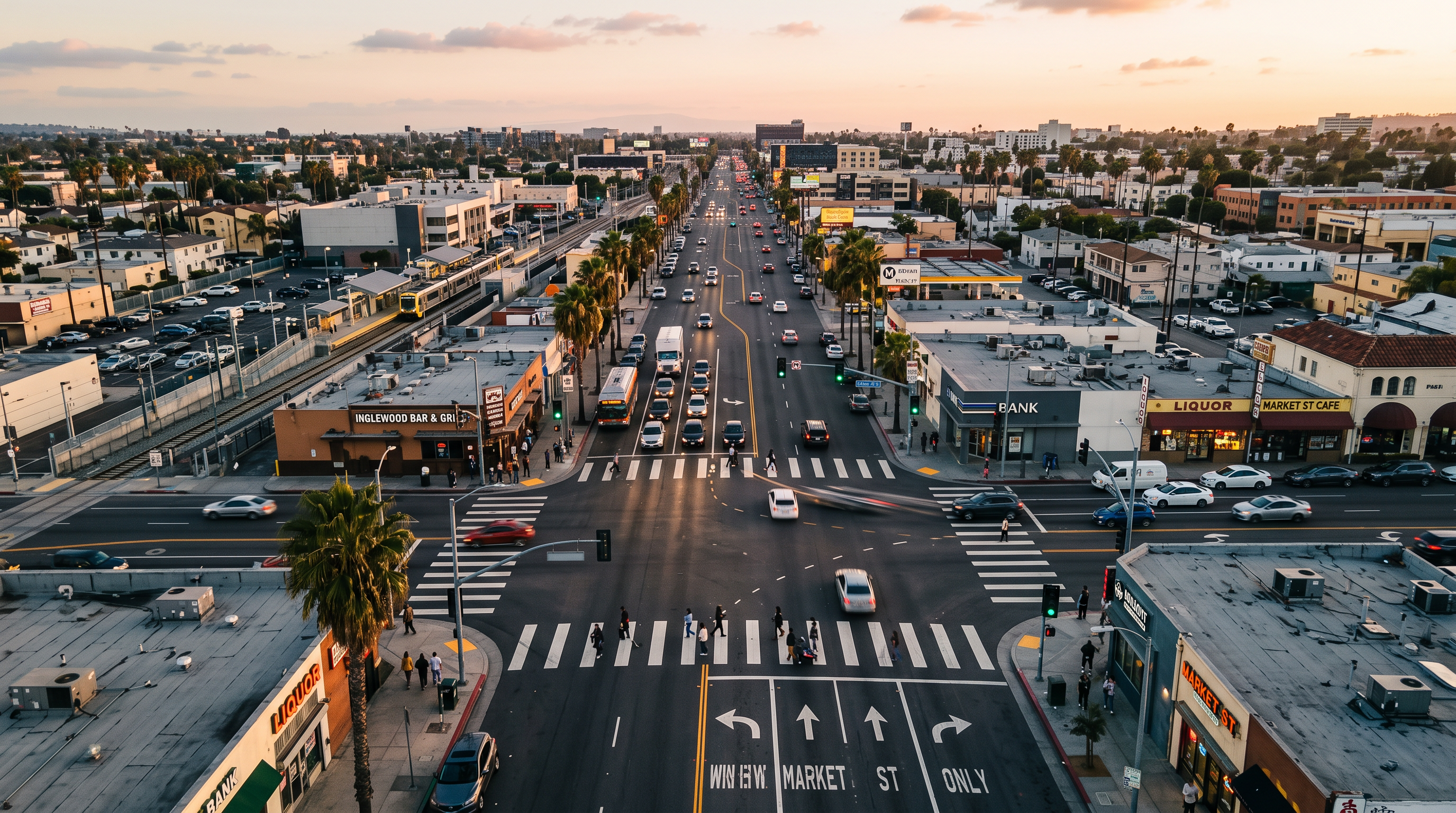
Car accident lawyer Inglewood guide to dangerous intersections
Inglewood drivers need a car accident lawyer who knows the local crash data: Inglewood recorded 1,184 crashes and 10 deaths in 2024, according to the California Highway Patrol's CCRS (data.ca.gov). In 2025 year-to-date data, Inglewood recorded 1,099 crashes, 633 injured people, and 7 deaths, according to the California Highway Patrol's CCRS (data.ca.gov). Those numbers explain why crashes on Century Boulevard, Florence Avenue, La Cienega Boulevard, Manchester Boulevard, and Prairie Avenue need fast evidence preservation.
Data source: California Highway Patrol, California Crash Reporting System (CCRS), data.ca.gov, public domain, updated July 30, 2026. California Open Data: CCRS.
| Type | Crashes | Injured | Injury Rate |
|---|---|---|---|
| Rear End | 288 | 145 | 50% |
| Broadside (intersection) | 255 | 235 | 92% |
| Side Swipe | 244 | 57 | 23% |
| Head-On | 88 | 77 | 88% |
| Vehicle/Pedestrian | 67 | 68 | ~100% |
| Hit Object | 127 | 40 | 31% |
| Source: CHP California Crash Reporting System, data.ca.gov. | |||
- Century Boulevard: heavy LAX spillover and commercial truck traffic
- Florence Avenue: high speed, limited signal spacing, frequent broadside crashes
- La Cienega Boulevard: multi-lane with high pedestrian conflict zones
- Manchester Boulevard: SoFi Stadium event surges create stop-and-go rear-end risk
- Prairie Avenue: I-405 connector with merge conflict and heavy freight
Which Inglewood Intersections Have the Most Crashes?
Inglewood's highest-risk corridors tend to combine speed, turning traffic, commercial vehicles, pedestrians, and drivers trying to beat congestion. Century Boulevard carries LAX spillover and heavy commercial traffic; Florence Avenue has fast-moving stretches with limited signal spacing; La Cienega Boulevard adds multi-lane vehicle movement and pedestrian conflict; Manchester Boulevard changes character when SoFi Stadium event traffic surges; Prairie Avenue funnels I-405 connector and truck traffic into local streets.
A crash on these corridors deserves a corridor-level evidence review, not just a driver-versus-driver blame analysis. The 2025 citywide total of 1,099 crashes and 633 injured people, according to the California Highway Patrol's CCRS (data.ca.gov), supports asking whether the location created a repeat hazard through signal timing, turn-lane pressure, visibility problems, or queue spillback.
If your crash happened near Centinela and Florence, Manchester and Prairie, or a Century Boulevard approach road, the exact point of impact matters. A collision that occurs before an intersection can still involve intersection-related danger if stopped traffic, a short turn pocket, a blocked sight line, or a freeway ramp queue forced drivers into unsafe decisions.
What Makes Broadside Crashes at Inglewood Intersections So Dangerous?
Broadside crashes injured 235 people in 255 reported Inglewood crashes in 2025, a 92% injury rate, according to the California Highway Patrol's CCRS (data.ca.gov). That rate matters because broadside collisions often place the force of the impact against a vehicle door, where occupants have less structure between their body and the striking vehicle.
Intersection broadside cases also turn on timing evidence. Lawyers need to know which driver had the green light, whether a protected left-turn phase existed, how long the yellow interval lasted, whether a red-light camera or nearby business camera captured the impact, and whether the same approach has a history of angle crashes.
The comparison to other crash types helps show why quick investigation matters. Rear-end crashes made up 288 crashes and injured 145 people, according to the California Highway Patrol's CCRS (data.ca.gov), while side-swipe crashes made up 244 crashes and injured 57 people, according to the California Highway Patrol's CCRS (data.ca.gov). Broadside crashes appear less forgiving in the Inglewood data.
How Do You Prove an Intersection Caused Your Crash?
You prove intersection fault by connecting the crash to physical conditions, traffic-control decisions, and prior warning signs, not by saying the intersection felt dangerous. Useful proof can include signal timing logs, collision-history records, lane-striping plans, sight-distance measurements, lighting conditions, police diagrams, dashcam footage, nearby camera footage, and witness statements about backed-up traffic or confusing turn movements.
For example, a driver who ran a red light at Centinela and Florence may carry fault, but the investigation should not stop there if multiple prior broadside crashes happened at the same approach. If poor sight lines, short yellow timing, a faded stop bar, or a blocked pedestrian phase contributed to the crash, those facts may affect fault allocation and available claims.
The same approach applies when the crash occurred close to an intersection. A collision near, but not inside, an intersection can involve a feeder road, turn-lane queue, driveway conflict, or freeway ramp backup that started at the traffic-control point and carried danger down the block.
What Should You Do If the City's Road Design Contributed to Your Accident?
If a city-owned signal, roadway defect, missing warning sign, dangerous sight line, or public road design contributed to your Inglewood crash, calendar the Government Claims Act deadline right away. California Government Code section 911.2 generally requires a claim against a public entity for personal injury to be presented within six months, which differs from the two-year deadline that often applies to ordinary personal injury cases under California Code of Civil Procedure section 335.1.
That shorter public-entity deadline changes the first steps after the crash. Your lawyer may need to send preservation letters, request signal and maintenance records, inspect the scene, identify the agency responsible for the roadway, and prepare the government claim before the ordinary insurance process finishes.
Do not assume the city is responsible just because an intersection is dangerous. A strong case identifies the public entity, the dangerous condition, the notice history, the maintenance or design records, and the way that condition helped cause your specific injuries.
Frequently Asked Questions
What type of intersection has the most accidents?
Intersections with heavy cross traffic, left turns, pedestrians, and inconsistent speeds tend to produce the most serious conflict points. In Inglewood, broadside intersection crashes stand out because 255 broadside crashes injured 235 people in 2025, a 92% injury rate, according to the California Highway Patrol's CCRS (data.ca.gov).
The most dangerous local patterns often happen where airport traffic, stadium traffic, trucks, and local commuters meet. Century Boulevard, Manchester Boulevard, Prairie Avenue, Florence Avenue, and La Cienega Boulevard each create different crash risks, so the evidence review should match the corridor.
Does it matter if my crash happened near but not at the intersection?
Yes. A crash near an intersection can still involve intersection-related liability if the collision came from a backed-up turn lane, a feeder road merge, a freeway ramp queue, a driveway conflict, or a signal pattern that pushed drivers into the same lane.
Distance changes the proof, not the question. Photos, measurements, police diagrams, and nearby camera footage can show whether the intersection controlled the traffic pattern that caused the crash.
I already gave a recorded statement to insurance, can I still pursue a claim?
Yes, you may still be able to pursue a claim after giving a recorded statement or signing some insurance paperwork, but the exact document matters. A recorded statement can create disputes about speed, pain symptoms, lane position, and whether you blamed yourself before you had medical records or crash evidence.
Do not give a second statement without legal advice if you think a dangerous intersection, city-owned signal, or road condition played a role. Bring the statement, claim number, release forms, and all insurer letters to the consultation so a lawyer can see what rights remain open.
How does event traffic near SoFi Stadium or LAX affect my accident claim?
Event traffic and airport spillover can affect liability by changing what a reasonable driver, property owner, traffic-control agency, or public entity should have expected at that location. Manchester Boulevard and Prairie Avenue can carry heavy SoFi Stadium waves, while Century Boulevard absorbs LAX traffic, commercial vehicles, hotel shuttles, rideshare stops, and drivers unfamiliar with local lanes.
That context can matter when a crash involves sudden stops, illegal turns, blocked intersections, pedestrian surges, or freeway spillback from I-405. The claim still needs specific proof, but event schedules, traffic-control plans, camera footage, and roadway records can help explain why the crash happened where it did.
How long do I have to file a personal injury claim after a car accident in Inglewood?
California Code of Civil Procedure section 335.1 generally gives injured people two years to file a personal injury lawsuit. If your claim involves a public entity, such as a city-owned signal, roadway design, missing sign, or dangerous public road condition, California Government Code section 911.2 generally requires a government claim within six months.
The safer move is to treat the deadline as urgent until a lawyer confirms who may be responsible. In 2025, Inglewood had 1,099 crashes and 633 injured people, according to the California Highway Patrol's CCRS (data.ca.gov), so evidence from public corridors can disappear while insurance paperwork is still moving.
Talk to an Inglewood Car Accident Lawyer
Lederer & Nojima investigates serious car accident cases in Inglewood, including intersection crashes, broadside impacts, pedestrian collisions, and roadway-design claims. If you were hurt on Century Boulevard, Florence Avenue, La Cienega Boulevard, Manchester Boulevard, Prairie Avenue, or another Inglewood corridor, contact Lederer & Nojima for a case evaluation.
If your crash happened outside Inglewood, you may also find our guides for a Culver City car accident lawyer and a Santa Monica car accident lawyer helpful.
People searching Reddit for an Inglewood car accident lawyer ask about fee structures, trial experience, and what to do before an adjuster calls. See what those Reddit discussions actually show.
Results may vary. Contact our office for a case evaluation.
Sources
- California Highway Patrol CCRS Crashes_2025: https://data.ca.gov/dataset/ccrs/resource/9f4fc839-122d-4595-a146-43bc4ed16f46
- California Highway Patrol CCRS Crashes_2024: https://data.ca.gov/dataset/ccrs/resource/f775df59-b89b-4f82-bd3d-8807fa3a22a0
- California Open Data CCRS: https://data.ca.gov/dataset/ccrs
- California Code of Civil Procedure section 335.1: https://leginfo.legislature.ca.gov/faces/codes_displaySection.xhtml?sectionNum=335.1&lawCode=CCP
- California Government Code section 911.2: https://leginfo.legislature.ca.gov/faces/codes_displaySection.xhtml?sectionNum=911.2&lawCode=GOV
This article is for informational purposes only and does not constitute legal advice.