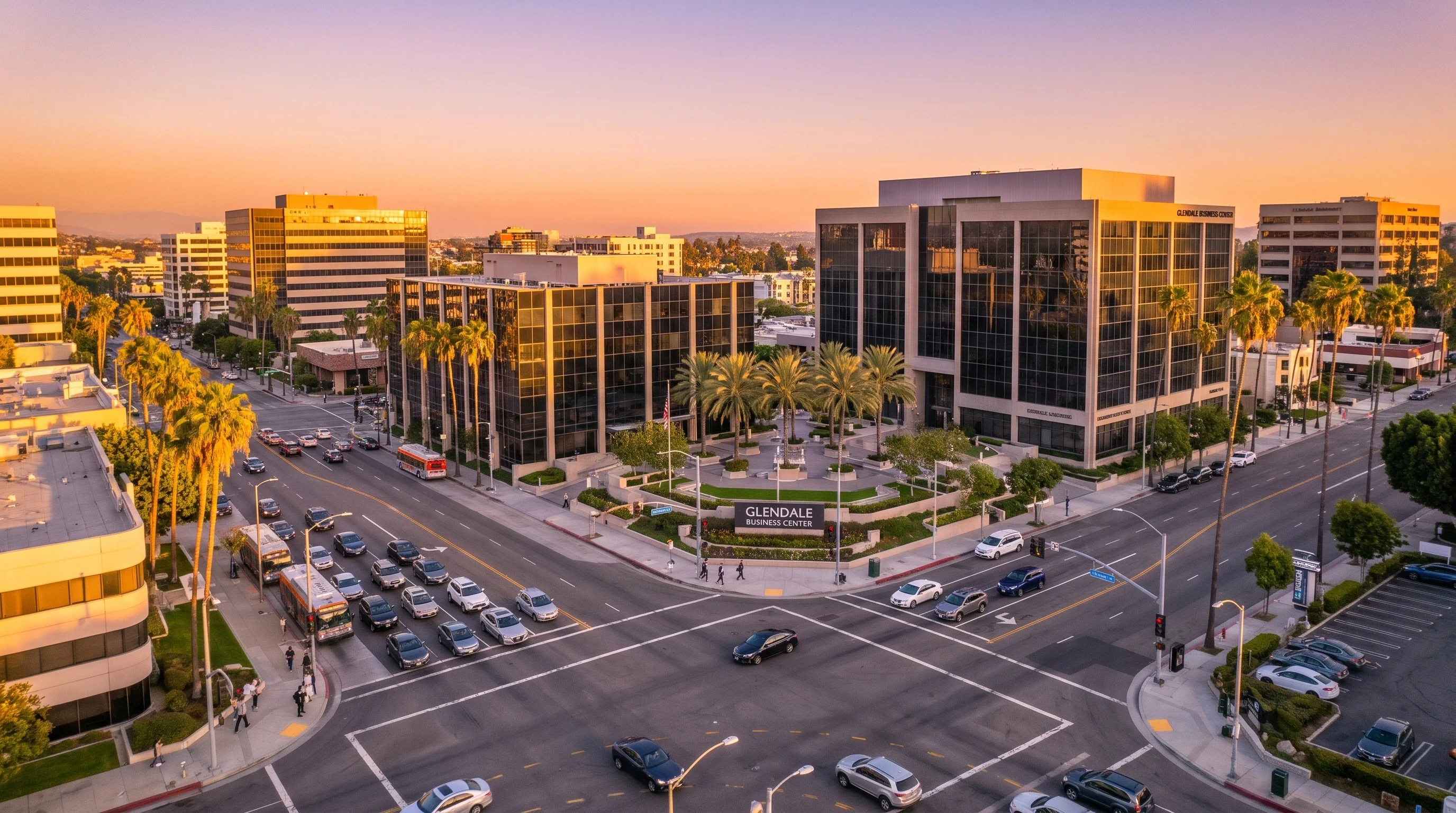
Car accident statistics in Glendale, CA: what the crash data shows
Car accident lawyer Glendale searches often follow a collision, but citywide crash statistics cannot establish who caused an individual wreck. California Highway Patrol records help explain the kinds of collisions Glendale reports; your photographs, medical records and witness accounts address what happened to you.
| Glendale measure | CHP CCRS 2025 total | What the count means |
|---|---|---|
| Reported crashes | 2,131 | Collision records, not injured people |
| People injured | 978 | People, not injury crashes |
| People killed | 3 | Fatalities, not fatal crashes |
| Rear-end crashes | 604 | A collision category, not a fault finding |
| Side-swipe crashes | 636 | A collision category, not an injury count |
Source: California Highway Patrol, CCRS, Glendale city-name records for 2025, queried November 16, 2026. CHP counts collisions separately from people, so each row keeps its own unit.
Sources
- California Highway Patrol, California Crash Reporting System (CCRS) via data.ca.gov
- California Legislative Information, Cal. Veh. Code § 16000 (current text) (published at leginfo.legislature.ca.gov)
- California Legislative Information, Cal. Veh. Code § 20008 (current text) (published at leginfo.legislature.ca.gov)
What do Glendale crash statistics establish?
CHP recorded city totals and collision categories for the reporting period, and those records say nothing about negligence in your case. The side-swipe total exceeds the rear-end total in this dataset, but neither category identifies which driver violated a rule or what evidence an insurer will dispute.
How do rear-end and side-swipe injury rates compare in Glendale?
California Highway Patrol's CCRS 2025 Glendale records, queried November 16, 2026, show 328 people injured in 604 rear-end crashes, compared with 128 people injured in 636 side-swipe crashes. Rear-end collisions were less frequent but accounted for more injured people.
Dividing those injury counts by their respective crash counts produces an injury-to-crash ratio of approximately 54% for rear-end collisions and 20% for side-swipes, calculated from the CHP CCRS figures. Expressed more precisely, those rates mean about 54 injured people per 100 rear-end crashes versus 20 per 100 side-swipe crashes. They do not mean that 54% or 20% of crashes involved an injury, or describe an occupant's chance of being hurt: a crash can injure multiple people. The comparison supports attention to medical evidence after a rear-end collision, not an assumption about fault or compensation.
What evidence should a Glendale driver preserve?
David Lederer describes the police report as a starting point for identifying witnesses, insurance information and roadway conditions. He also recommends looking for nearby business or residential cameras and asking for the footage to be preserved. An officer's initial assessment and a statistical category both fall short of an investigation.
Frequently asked questions
Is a lawyer needed for a car accident?
Not every property-damage collision in Glendale requires an attorney. Lederer recommends discussing an injury claim with counsel when treatment or an insurer's response raises questions about causation, medical costs or the extent of injury.
What should I tell my personal injury lawyer?
Describe the Glendale collision and your symptoms without guessing. Include prior injuries, delayed symptoms and correspondence that challenges your account so the attorney can evaluate those issues.
How much is my injury case worth?
City crash totals cannot answer that question. Counsel needs evidence of fault, injury, treatment and available coverage before evaluating a claim; an evaluation does not guarantee a result.
What if the other driver's insurer accepts fault?
Acceptance of fault does not resolve every question about injury or payment. Ask which parts of your claim the insurer still disputes before treating an offer as a complete resolution.
How should you use collision types without overstating them?
A collision category raises questions for the investigation; it is not a finding about the driver's conduct. A side-swipe label, for example, leaves open which vehicle changed lanes, where each vehicle traveled beforehand and whether another vehicle affected the movement.
The CHP CCRS rear-end count of 604 and side-swipe count of 636 describe Glendale's recorded 2025 collisions. Neither figure tells you how many drivers admitted fault, how many people hired lawyers or what insurers paid. The city data contains no settlement amounts, so any estimate would be invented.
For your own crash, preserve the original photographs rather than a screenshot of a compressed message. Keep the sequence intact when the photographs show vehicle positions before a tow. If you moved your vehicle, explain when and why so the attorney does not mistake a later position for the point of impact.
Write down the exact location, direction of travel and lane information you remember. A reference to Brand Boulevard or Glenoaks Boulevard helps identify a location; it does not establish a statistically dangerous segment. The verified city figures do not rank those streets.
Ask a witness what they saw, rather than suggesting an answer. Keep the witness's contact information and tell your attorney whether the witness saw the impact or arrived afterward. Those accounts answer different questions. A photograph of damage may support part of the account while leaving the vehicle movements unresolved.
Why does the medical timeline matter after a collision?
The medical timeline helps counsel compare the reported symptoms with treatment records and the insurer's objections. Give your provider an accurate history. Do not alter your description to fit a claim theory or omit a prior condition because you worry about its effect on the case.
In his account of handling injury claims, David Lederer distinguishes a clear liability dispute from a dispute about injury. He has seen insurers question whether a collision caused the claimed symptoms and whether treatment was necessary even when fault did not drive the disagreement. An admission about the collision therefore leaves the medical evidence open.
Lederer also cautions that a person may not understand the extent of an injury after a crash. Document what happened when, including symptoms you noticed later, without making a diagnosis yourself. Medical professionals assess the condition; an attorney reviews how the available evidence relates to the claim.
Keep appointment records and the communications you receive about treatment or billing. If the insurer challenges a gap in care, tell counsel the reason for the gap rather than inventing an explanation. Ask your clinician about treatment decisions. A claim does not require you to replace clinical judgment with an insurance adjuster's preference.
A citywide count cannot demonstrate that a particular collision caused a specific injury. Even a report that lists an injury does not answer every later question about diagnosis, duration or care. Your individual records supply the detail that aggregate figures leave out.
How does our office begin reviewing a Glendale claim?
We start with the collision account and the records available to test it. In David Lederer's description of the process, the police report supplies leads: parties and insurance, witness contacts, reported conditions and possible vehicle-code issues. Counsel then pursues the underlying information instead of treating the report as the whole case.
Camera footage gets its own attention. Lederer describes canvassing nearby businesses and residences to identify cameras that might show the incident, then seeking preservation of relevant material. A camera you can see from the road may not have recorded the impact. Tell counsel what you observed so the office can investigate.
During a consultation, separate a document you possess from a document you believe exists. Bring the insurer letter if you have it. If you only remember a telephone conversation, write down the speaker and your recollection without presenting it as a verbatim transcript.
Ask the attorney which issues remain unresolved: vehicle movement, coverage, medical causation or a reimbursement demand. A useful case review identifies the disputed issue and the records needed to address it. A promised payment based only on a collision category would skip that work.
Our Westside office represents injury clients beyond its Wilshire Boulevard address. The firm's car accident representation information explains a related practice area, and the contact page lets you arrange a discussion of your own circumstances. Glendale city statistics provide context and set no boundary on who can ask for an evaluation.
What should you check before accepting a settlement?
Ask what the proposed agreement resolves and which financial obligations remain. An offer amount alone does not explain unpaid treatment or a potential reimbursement claim. Bring those documents into the review rather than assuming the insurer's figure equals the money you will retain.
Do not calculate a personal recovery from Glendale's injury count or from an unrelated verdict. The dataset describes a population of reported collisions. It contains no record of your treatment needs, the relevant policy terms or the evidence each party could present.
An insurer's factual position and a legal conclusion are different things. A letter may accept a collision account while disputing a treatment expense. Have counsel identify the disagreement, explain the available options and evaluate timing based on your circumstances rather than a generic citywide guide.
For reporting on disputed allegations after a collision, read our La Honda crash lawsuit news.
Discuss your Glendale collision
Contact Lederer & Nojima LLP at (310) 312-1860 to request a case evaluation. Our office is at 12100 Wilshire Boulevard, Suite 480, Los Angeles, CA 90025. Tell the office where your collision occurred and which documents or insurer questions you need to discuss.
Results may vary. Contact our office for a case evaluation.
This article is for informational purposes only and does not constitute legal advice.